

Parents spend a lot of time and money on activities that promise to teach their kids something. STEM camps. Music lessons. Sports clinics with names like "leadership through lacrosse." These all have value. But the most effective teaching tool your family might encounter this weekend is already waiting at your nearest AMF, and it's been there the whole time. It's the bowling scoreboard.
That screen above your lane is doing more developmental work than it gets credit for. Every frame is a math problem. Every turn is a lesson in patience. Every spare and every gutter ball is a crash course in emotional regulation. And none of it feels like learning because the kid is having too much fun to notice. The best parenting tools are the ones that don't announce themselves, and the bowling scoreboard is quietly one of the most effective ones in your rotation.
The math lesson nobody has to sit still for
Ask a seven-year-old to practice addition at the kitchen table and you'll get approximately four minutes of compliance before the fidgeting starts. Put the same kid in front of a bowling scoreboard and they'll voluntarily do arithmetic for an hour without a single complaint. The math is built into the game. How many pins did I knock down? How many are left? What's my score now? If I get a spare, what happens next?
Older kids start engaging with the scoring system's more complex mechanics. Strikes and spares carry forward, which introduces the concept of cumulative scoring and delayed gratification in a way no worksheet can replicate. A ten-year-old who figures out that a strike in the ninth frame affects the tenth frame is doing mental math that would make their teacher proud, and they're doing it because they want to, not because they have to.
The scoreboard also introduces comparison and ranking in a healthy, contained environment. Kids can see their score next to their siblings' or parents' scores. They learn to read a leaderboard, track their progress across frames, and set goals for the next game. These are the same skills that underpin everything from academic performance tracking to career development, delivered through a game that asks nothing of the parent except to keep ordering from the menu and let the lanes do the teaching.
Patience, turn-taking, and the art of waiting your turn
Modern childhood is an on-demand experience. Screens deliver entertainment the instant a child touches them. Apps respond in milliseconds. The concept of waiting, truly waiting, for something you want has been engineered out of most of a kid's daily life. Bowling reintroduces it in a way that feels natural instead of punishing.
Every game requires waiting. Your turn comes after your sibling's turn. You bowl your first ball, then you wait for the pins to reset before your second. Between frames, you sit, watch others play, cheer, strategize, and manage the anticipation of your next turn. For a generation of kids who've never had to wait for anything, this is quietly revolutionary.
The patience muscle that bowling builds extends beyond the lanes. Kids who practice waiting in a fun, low-stakes environment are better equipped to handle waiting in higher-stakes ones: the classroom, the sports field, the dinner table. AMF's experiences create a structure where turn-taking is baked into the activity itself. Nobody has to lecture a child about patience when the game already requires it. The lane does the parenting.
Winning, losing, and everything in between
Every parent wants to raise a gracious winner and a resilient loser, but finding safe environments to practice both is harder than it sounds. Youth sports often amplify the stakes to a level where losing feels devastating and winning breeds arrogance. Board games at home devolve into arguments between siblings. Video games offer wins and losses but strip away the social dimension that makes sportsmanship actually matter.
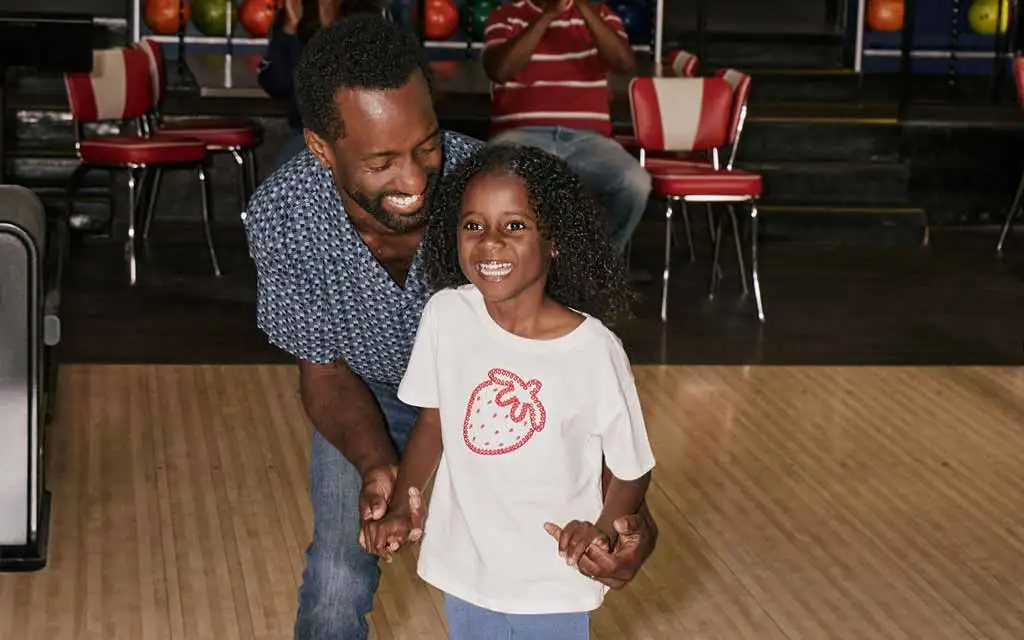
Bowling threads the needle perfectly. The stakes are real enough to matter, a kid genuinely wants to knock down all ten pins, but low enough that a bad frame doesn't ruin the day. A child who bowls a gutter ball gets to try again thirty seconds later. A child who bowls a strike gets to celebrate without anyone else feeling diminished. The game resets constantly, offering a steady rhythm of small wins and small setbacks that teach emotional regulation in real time.
Parents can model the behavior they want to see. Cheer for your kid's spare. Laugh at your own gutter ball. Congratulate a sibling who outscored you. These micro-moments add up. Over ten frames, a child absorbs more about sportsmanship than most organized sports teach in an entire season. And because the whole family is playing together, the lessons land harder than they would coming from a coach on a sideline.
Let the scoreboard do the parenting
The best family activities are the ones where learning happens invisibly, where the kid walks away with skills they didn't know they were building and memories they'll associate with fun instead of obligation. Bowling at AMF delivers exactly this. Math, patience, sportsmanship, emotional regulation, goal-setting: it's all encoded in the game itself.
Check out the latest specials at AMF, find a location near you at the location finder, and introduce your family to the parenting tool that's been hiding at the end of the lane this whole time.